
Airport Stay Advisor
Recommended Option
Adjust the settings to see the best recommendation.
Key Takeaways
- They solve the "dead time" problem during long layovers.
- They reduce the risk of missing early morning flights due to traffic or transport failures.
- They provide a sanctuary for crews and passengers during flight cancellations.
- They cater to the specific needs of business travelers who prioritize efficiency over sightseeing.
The Logistics of the Layover
The primary reason these hotels exist is the reality of Flight Schedules. Planes don't always land when it's convenient for your sleep cycle. When you have a layover that lasts between 8 and 24 hours, you hit a "grey zone." You're too tired to explore a new city, but too awake to survive on a plastic airport chair for the rest of the night.
By placing a hotel directly on the tarmac or within a short shuttle ride, airports eliminate the friction of urban transit. Think about the stress of navigating a foreign city's subway system at midnight. An airport hotel removes that variable entirely. You move from the jet bridge to a shower and a bed in minutes, allowing your body to reset before the next leg of the journey.
The "Early Bird" Insurance Policy
Have you ever woken up at 3 AM to catch a 6 AM flight, praying that the taxi actually shows up? That anxiety is a huge driver for the Hospitality Industry to build near terminals. For many travelers, paying a premium for a room at an airport hotel is essentially buying insurance against traffic jams, strikes, or broken-down shuttles.
This is particularly vital for business travelers. If a CEO has a million-dollar deal riding on a presentation in another city, they can't risk a missed flight because of a fender-bender on the motorway. Being within walking distance of the check-in counter turns a high-stress morning into a controlled, predictable process.
A Safety Net for Aviation Disruptions
Aviation is a fragile system. One bad storm in Atlanta or a technical glitch in Heathrow can trigger a domino effect of cancellations across the globe. When hundreds of flights are grounded, thousands of passengers are suddenly stranded. In these moments, airport hotels transition from a luxury to a critical piece of Infrastructure.
Airlines often have contracts with these hotels to house displaced passengers. Instead of leaving people to sleep in the terminal-which creates security and hygiene issues for the airport-the airline moves them into nearby rooms. This keeps the terminal clear and keeps the passengers from becoming completely overwhelmed by the stress of the delay.

Catering to the Crew
While we usually think about passengers, Flight Crews are some of the most consistent users of these hotels. Pilots and cabin crew have strict legal requirements regarding "rest periods." They can't just crash on a couch in the crew lounge; they need a regulated amount of undisturbed sleep to ensure flight safety.
Airport hotels provide a standardized environment where crews can recover from jet lag and prepare for their next rotation. Because these hotels are so close to the aircraft, crews can maximize their actual rest time and minimize the time spent commuting to and from the cockpit.
Comparing the Types of Airport Lodging
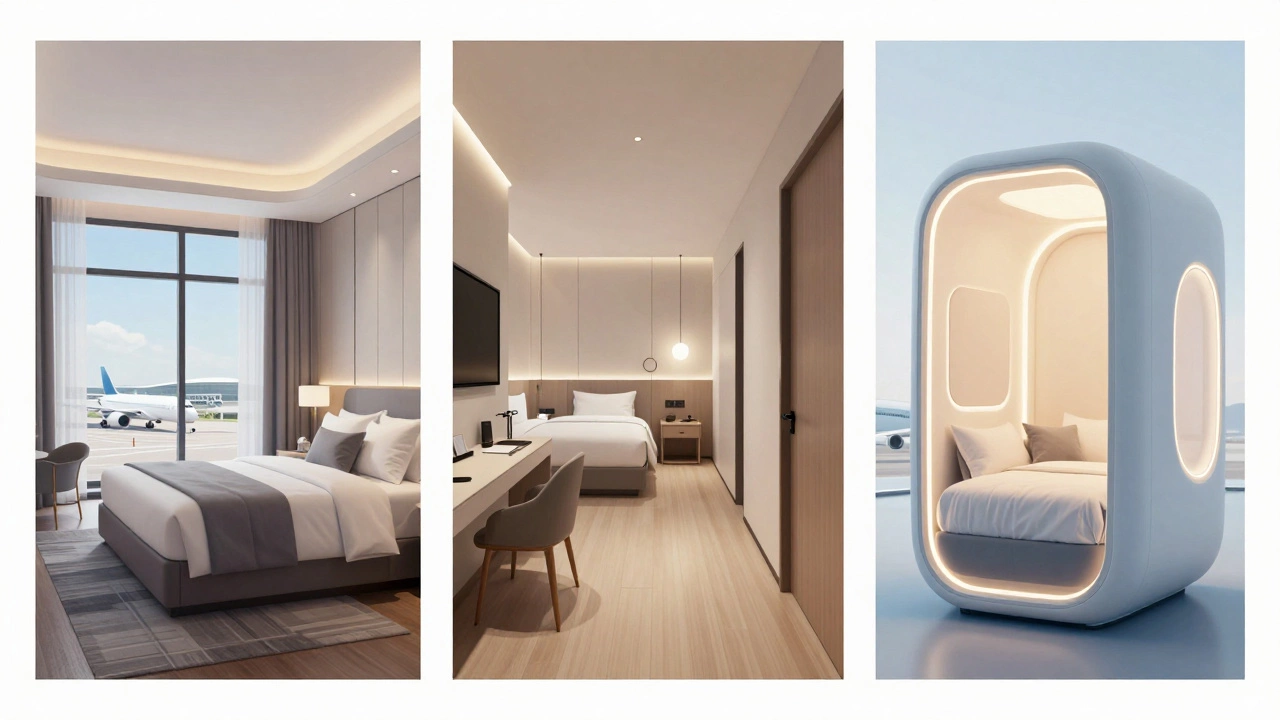
Not all airport stays are the same. Depending on your needs, you might choose a full-service hotel, a transit hotel, or a sleep pod. Each serves a different "job" for the traveler.
| Type | Location | Best For... | Key Attribute |
|---|---|---|---|
| Full-Service Hotel | Outside Perimeter | Overnight stays / Business | Amenities (Gym, Dining) |
| Transit Hotel | Airside (Post-Security) | Short layovers (6-12h) | No need to clear customs |
| Sleep Pods | Inside Terminal | Power naps (2-4h) | High efficiency / Low cost |
The Psychology of the Transit Space
There's a strange phenomenon known as "non-places." These are spaces like airports, malls, and motorway service stations that don't hold a specific identity. They are designed for transition. For some, this is boring, but for others, it's a relief. An airport hotel provides a controlled, predictable environment where you don't have to worry about the local culture, language barriers, or finding a decent meal.
For a weary traveler, the predictability of a global hotel chain located at the airport is a psychological comfort. You know exactly what the bed will feel like, how the shower works, and that the Wi-Fi will be functional. This eliminates the cognitive load of navigating a new environment when your brain is already foggy from a 10-hour flight.
Strategic Location and Real Estate
From a business perspective, airport hotels occupy some of the most valuable real estate in the world. They benefit from a "captive audience." When a flight is cancelled at 2 AM, the passenger isn't going to browse a variety of hotels in the city center; they are going to go to the closest available bed. This allows airport hotels to maintain high occupancy rates and often charge a premium for the convenience of their location.
These hotels are often integrated into the Airport Master Plan, ensuring they have dedicated access roads and shuttle lanes. This integration means they function almost as a department of the airport itself, rather than a separate business entity.
Do I need to clear customs to stay at an airport hotel?
It depends on the hotel's location. If the hotel is "landside" (outside the secure area), you must clear immigration and customs to reach it. If it is a "transit hotel" located "airside" (inside the secure area), you can stay there without ever leaving the airport's controlled zone, which is ideal for those without a transit visa.
Are airport hotels more expensive than city hotels?
Often, yes. You are paying a convenience fee for the location. While you might find a cheaper room 20 minutes away in the city, the cost of the taxi and the time spent traveling often offset the savings. However, during peak travel seasons, city hotels may actually be more expensive due to tourism.
Can I book a room for just a few hours?
Many airport hotels and transit hotels offer "day rates" or hourly bookings. This is specifically designed for travelers who only need a shower and a nap before their next flight, rather than a full overnight stay.
What is the difference between a transit hotel and a sleep pod?
A transit hotel is a full hotel experience-bed, bathroom, and service-located inside the terminal. A sleep pod is a small, enclosed capsule that provides a bed and some privacy, but usually shares a communal bathroom and lacks the full amenities of a hotel room.
Do airlines pay for these hotels if my flight is cancelled?
In many cases, yes. Depending on the airline's policy and the reason for the delay (like a mechanical failure), the airline will provide a voucher for a nearby airport hotel. However, if the delay is due to "acts of God" like severe weather, the airline might not be legally obligated to pay, though many still do to maintain customer satisfaction.
Next Steps for Travelers
If you're planning a trip with a long layover, don't wait until you land to find a bed. During a major system outage or a storm, airport hotels fill up in minutes. Book your room as soon as you see a gap in your itinerary that exceeds 8 hours.
For those on a budget, check if your airport has a "transit zone" hotel. This saves you the hassle of baggage reclaim and passport control. If you only have 4-5 hours, look for sleep pods or lounge access, which often provide a quiet space to nap without the cost of a full hotel room.